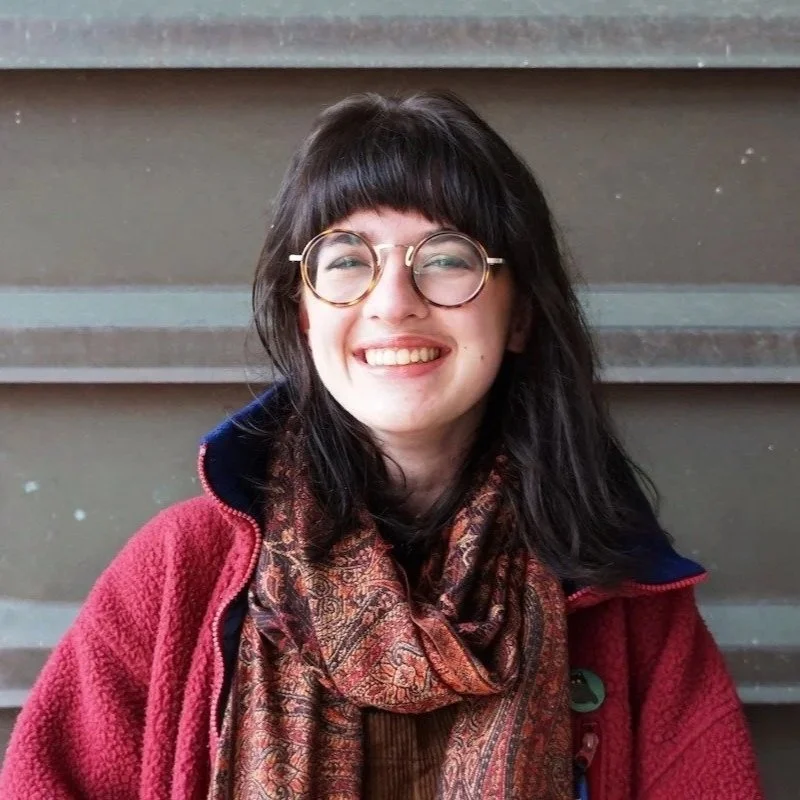
Chloe Lundrigan
Affilliation: Memorial University of Newfoundland and Labrador
Chloe Lundrigan is an artist of Irish, Welsh, and English ancestry raised as a grateful guest along the tidal mudflats of Siknikt, Mi’kma’ki (Tantramar, New Brunswick, Canada) who believes in the everyday magic of vernacular traditions. Their sculptural and community-based practice is informed by craft inheritances, archival research, and a profound care for the lifeways of rural Atlantic Canadian communities. Lundrigan lives on unceded Beothuk land (St. John’s, Newfoundland and Labrador, Canada), where they’re finishing their Master of Arts in Folklore.
Panel: Folk Artefacts and the Cultural Commons
In 2025, I founded Memorial University of Newfoundland Folklore and Language Archives’ (St. John’s, Newfoundland and Labrador, Canada) first artists in residence program: LAIR!. Over nine months, a cohort of five – zinester, puppeteer, oil painter, dance-caller, fiddler – received training and support from the archive’s team to develop independent projects ranging from re-animating an undersung Jewish cultural organization in our city, to writing a site-specific shadow-play using local expressions of an outport community, to building a database of musique Franco-Terre-Neuvien et macaronique (French-language and Acadian folk music). None of the artists had previously used archives in their work.
LAIR! was designed to support creative activations of MUNFLA’s collection, decrease barriers to using archives through hands-on experience, and to share appreciation for and critical engagement with Newfoundland and Labrador’s documented and under-documented folk cultures. It exists as a deliberate and explicit invitation to experts of other knowledge systems to occupy and feel ownership over institutional space.
Drawing from interviews with the artists and personal reflections, this paper provides an introduction to the context of Folklore studies in Atlantic Canada, covers learnings from the first edition of LAIR!, and considers active stewardship as a creative practice, where the folklorist plays the role of host, translator, carnival barker, rather than observer, collector, or presenter.