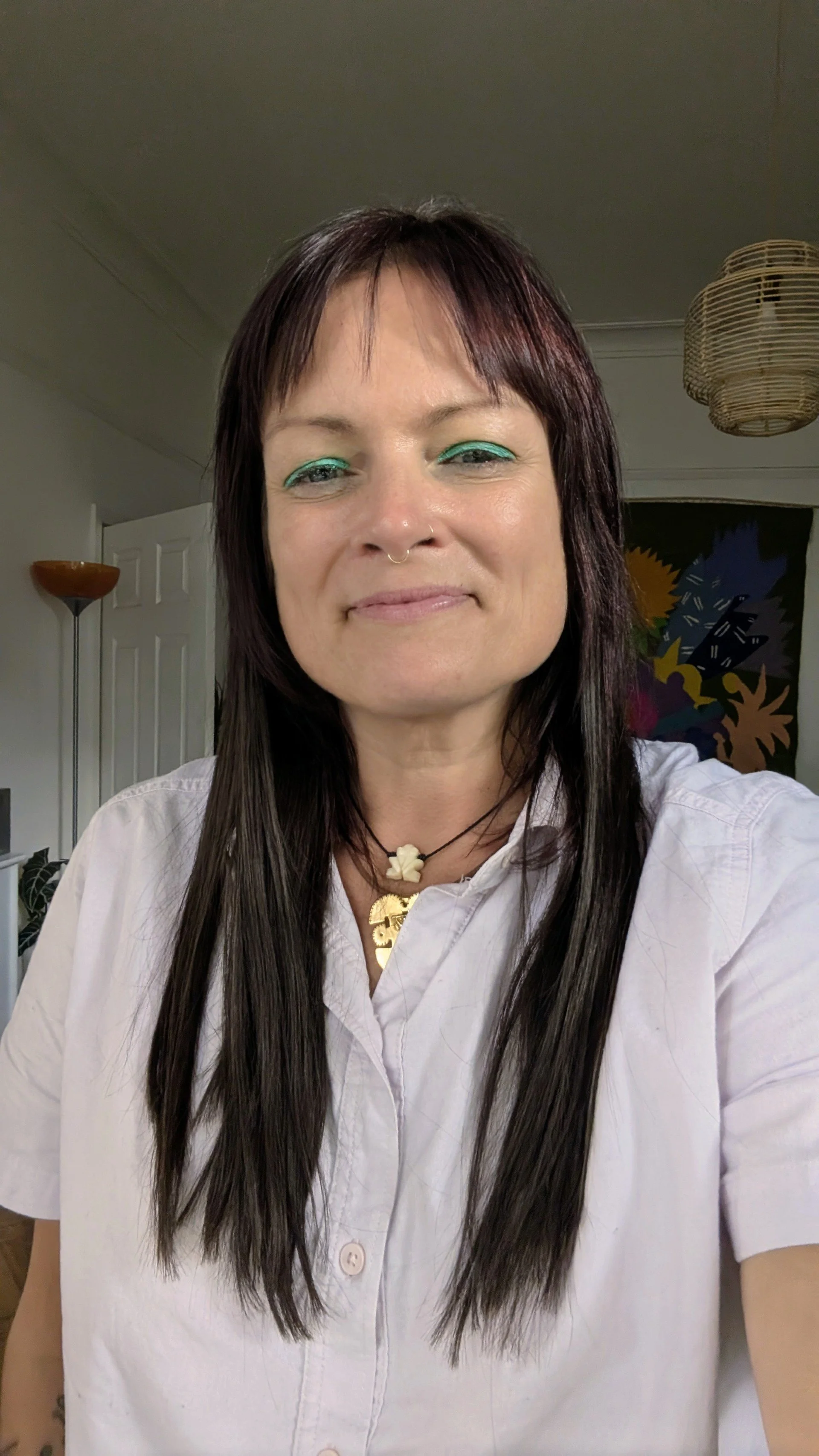
Becky Dodman Wainwright
Affiliation: Arts University Plymouth
Becky Dodman Wainwright is an experienced textile artist, weaver, and academic with 13 years of experience, currently serving as the Postgraduate Course Leader at Arts University Plymouth. Her practice is built on an "Othered" aesthetic derived from her mixed British, Chinese, and Colombian ancestry, specifically the Altiplano Cundiboyacense and Andean Indigenous heritage. Committed to decolonial research, she focuses on transforming personal experiences of severed heritage into rigorous, reciprocal methodologies. With 15 years of community work experience, her work explores the intersection of ritual, textile languages (such as Wayuu kaanás and Inga labores), and socially engaged practice.
Panel: Folk Artefacts and the Cultural Commons
Talk Title Chumbé, cosmologies and the exploration of ancestral Colombian heritage: A new model for non-extractive (auto)ethnographic textile research.
This research, titled "Chumbé, cosmologies and the exploration of ancestral colombian heritage: A new model for non-extractive (auto)ethnographic textile research", examines the chumbe—a traditional woven sash of the Inga and Kamentsá peoples—as a living form of historical and cosmological inscription. Rooted in a personal journey to reconnect with severed Colombian ancestral heritage linked to the Misak and Pijao communities in the High Andes of the Cauca region of Colombia, this work addresses the colonial-era displacement and erasure of Indigenous
knowledge.
The chumbe functions as both a cultural and "mental artefact", serving as a mnemonic-storytelling device. Traditionally woven on a backstrap loom, it utilises a process described as "weaving with the mind". This mathematical and mnemonic exercise requires the weaver to form intricate geometric pictograms, known as 'labores', from memory without written patterns. These labores narrate the Inga worldview, representing the human being (family and womb), nature (sun and water), and space-time.
Beyond its aesthetic value, the chumbe possesses therapeutic and spiritual significance. Its most critical function is the protection of the womb, viewed as the centre of life and a parallel to the life-giving Earth (Pachamama). Historically, the belt served as an instrument of social resistance; despite colonial efforts to ban Indigenous dress, it survived as a private and public symbol of identity against cultural erasure.
By moving beyond the extraction and romanticisation often found in heritage textile research, this project proposes an ethical, reciprocal methodology termed "Woven Kinship". The research explores how ancient "arts of memory" can ethically inform contemporary art and design. It seeks to create new textile practices that embody ancestral knowledge, fostering a reciprocal flow of wisdom that supports diversity and intergenerational healing in a post-colonial landscape.