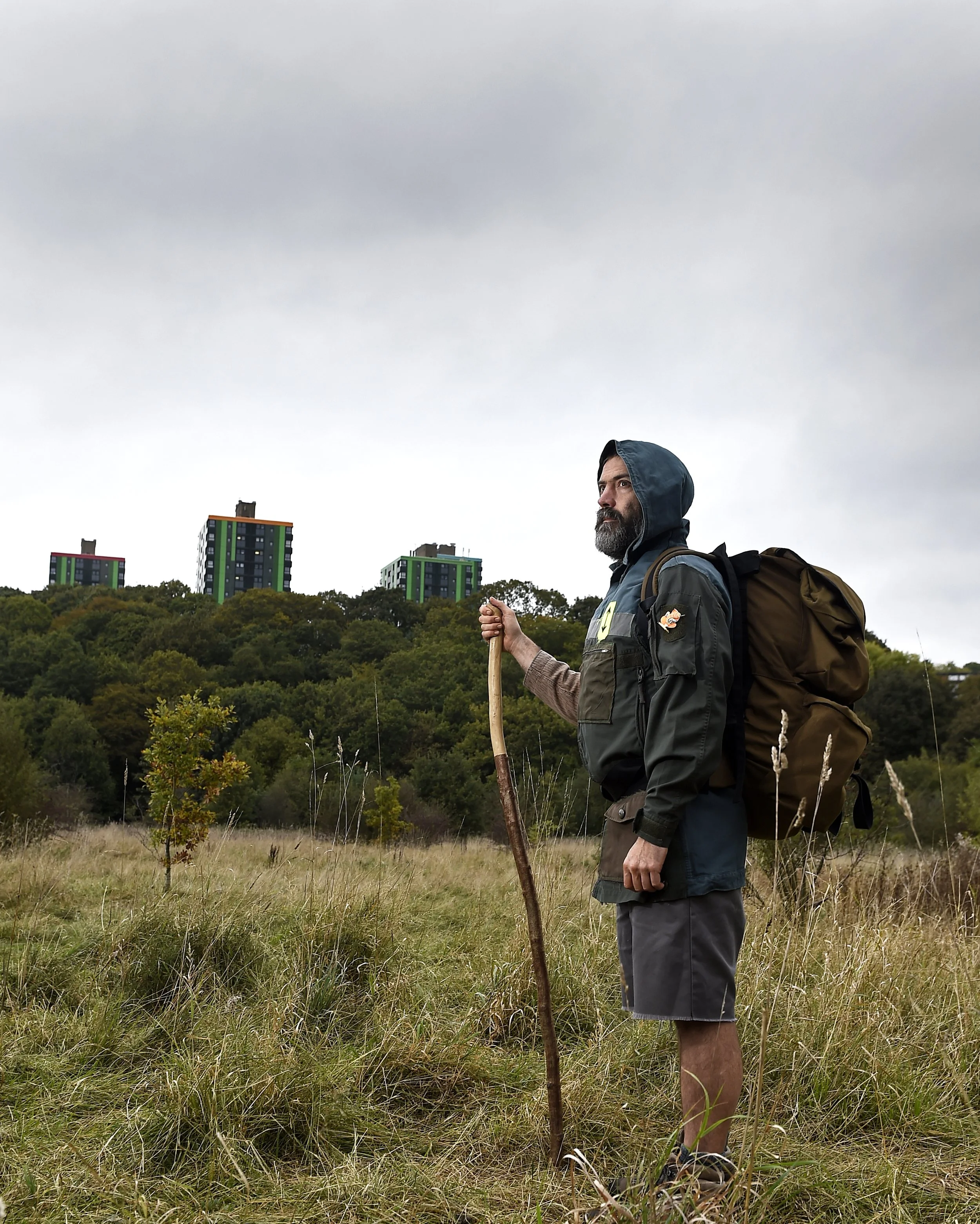
Ian Nesbitt
Affiliation: Independent
Panel: Pilgrimage, Procession, Pageantry
Ian Nesbitt is a socially engaged artist, filmmaker, writer, and pedestrian based in Sheffield. His practice reflects on what it means to practice togetherness in collapsing systems. Working alongside citizens, communities and the more-than-human to hold spaces for exchange that reach beyond the everyday, he seeks to further emergent readings of these entangled territories.
‘A Measure Of Care’, a video installation made in collaboration with Ruth Levene, is on display at Harris Museum (Preston) until October 2026. In the first half of 2026, his work can also be found at Supersonic, Migration Matters and Offbeat Folk Film festivals.
Talk Title: Pilgrimage as Hospicing: Walking Through the Debris of Modernity
Drawing on the artist’s journals, field recordings and super-8 footage, this presentation takes an autoethnographic approach to the exploration of pilgrimage as an embodied and relational artistic field practice. Rooted in concepts such as Hospicing Modernity (Vanessa Machado De Oliveira) and Deep Listening (Pauline Oliveiros), it proposes a mode of be(com)ing human within the overlapping ecological, cultural, and existential crises of the present, with walking as a slow methodology for attending to endings, thresholds, and emergent possibilities.
Here, walking is a mode of inquiry, witnessing, and care: a durational act of accompaniment with folkloric histories of place, fractured communities, damaged landscapes, and the more-than-human. A therapeutic relationship with landscape can be achieved, which includes the landscape itself as an actor, generated through attention, listening, and relational presence. To hospice is not to fix or redeem, but to remain present with what is passing while cultivating conditions for dignity, reciprocity, and imagination. Walking thus becomes a participatory ethics: a way of sensing from within collapse while staying responsive to what calls for care.
The presentation argues that pilgrimage, understood in this way, offers an emergent methodology for contemporary practice, research and healing, inviting us to ‘treat the body moving through the land as a site of reckoning’ (Roxana Perez-Mendez), and inviting co-pilgrims to inhabit uncertainty together, while rehearsing forms of collective presence within the debris of modernity.