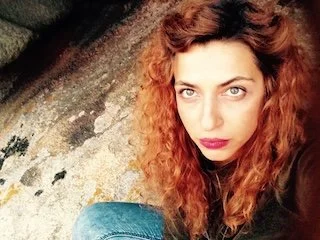
Sara Svati
Affilliation: Independent artist and researcher, Orientale Sarda
Panel: Experiential Archaeologies
Sara Svati is an artist and independent researcher, founder of Orientale Sarda. Trained in classical dance and visual arts, she develops a practice spanning directing, dramaturgy and contemporary scenography. Her work, presented across Europe and the UK, weaves language, sound and contemporary dance into space design, mapping eco-feminine practices, esoterica and technologies for performance.
Sara Svati and Orientale Sarda disseminate knowledge through workshops, labs and presentations across institutions in the UK and Europe, including the Prague Quadrennial Symposium, European Culture and Technology Laboratory (ECT Lab+), and performance laboratories.
Talk Title: “Stones’ Listening: Trulli, Cosmology and the Poetics of Place”
My research explores the trulli of Apulia over more than two decades, focusing on these limestone dwellings as vessels of ancestral and cosmological knowledge. The trulli preserve traces of practices in which communities inhabited both visible and invisible dimensions of the world. Their painted motifs, acoustic properties, and pinnacles functioned as cosmological instruments, maintaining balance between human, more‑than‑human, and cosmic realms. Today, this knowledge faces existential risk from cultural erosion, mass tourism, and the flattening of symbolic meaning into the picturesque.
The presentation offers a methodological reflection on a mythopoetic process, in which I draw from comparative studies across visual art, ethnography, local history, myth, cosmology, and esoteric studies. As an artist with a background in theatre and performance studies, the work proposes artistic research as a form of listening and poetic knowing, where magic, myth, and symbolic systems shape relations with landscape, multiple temporalities, and dimensions.
By attending to the trulli as living architectures of cultural memory, the research explores how restoring analogical thinking and preserving oral and unwritten histories can help us rekindle a relationship with the genius loci and the natural world, countering extractive and colonial attitudes that have long altered both land and cultural memory. As a singular example of vernacular architecture, the trulli stand as thresholds of understanding, restoring embodied and ecological awareness amid contemporary cultural, political, and spiritual crisis.